What to read before your Executive MBA starts
By Antoine Marchand · Last reviewed
Why this list
The people who struggle in the first term of an Executive MBA are rarely short of experience. They are short of a few specific tools: reading financial statements, discounting cash flows, interpreting a regression, using basic economic vocabulary. Those gaps cost the most time early, because the first courses tend to assume them and move on.
So this list front-loads the quantitative gaps and keeps the general primer to a single book at the start. The order runs from orientation, to accounting, to corporate finance, to statistics, to economics. Each book is short, cheap and written for someone learning alone.
I left out the big textbooks on purpose. Your program will assign the ones it wants, and buying them ahead of time is a good way to spend money on the wrong edition.
How to use it
If you have four months, read roughly two books a month, in the order given. If you have six weeks, read the two accounting books and Naked Statistics, then stop; those three cover the gaps that slow people down most.
Skip any book whose subject you already use at work. A finance director does not need Accounting Made Simple, and an engineer who runs regressions can skip Naked Statistics. Spend that time on the subject you are least comfortable with instead.
Keep a short list of questions as you read. Anything that still confuses you after the book is exactly what to ask in the first week, when professors expect those questions.
The list
1 
The Personal MBA
Josh Kaufman · 2010 · Foundation · about 9 h · $
Read this first, in the first month after you accept your place. It is a broad, plain-language tour of how a business works, and its job here is orientation: by the time your first course starts, you will have heard of most of the concepts on the syllabus and know roughly where each one fits. Do not take notes. Read it quickly and treat it as a map.
2 
Accounting Made Simple
Mike Piper · 2008 · Foundation · about 2 h · $
Accounting is the gap that hurts most in the first weeks, so it comes second. Piper's book is short and starts from the accounting equation, then builds the balance sheet and income statement on top of it. It assumes nothing. If you have never had to read a set of accounts, this is the gentlest way in, and it can be finished in a weekend.
Full review comingBuy on Amazon ↗
3 
Financial Intelligence
Karen Berman & Joe Knight · 2006 · Foundation · about 7 h · $
Once the mechanics make sense, move to a book that teaches you to use them. Berman and Knight are writing for managers who need to read statements, question them and connect them to decisions, with a strong section on cash.<!-- VERIFY --> It is the step between knowing what a balance sheet is and being able to say something useful about one in a study group.
4 
The Little Book of Valuation
Aswath Damodaran · 2011 · Foundation · about 5 h · $
Corporate finance usually arrives early in the program, and discounting is the idea that trips people up. Damodaran explains present value, risk and growth in plain terms and applies them to real kinds of companies. It sits after the accounting books because valuation is built on the statements. Work the examples with a spreadsheet open; that habit pays off in class.
Full review comingBuy on Amazon ↗
5 
Naked Statistics
Charles Wheelan · 2013 · Foundation · about 8 h · $
Many EMBA programs put a statistics or data course in the first year, and it is the course mid-career students most often dread.<!-- VERIFY --> Wheelan explains distributions, sampling, correlation and regression with examples rather than proofs. It will not teach you to run the analysis, but it will make sure the first lecture on regression is a refresher of the intuition rather than a shock.
Full review comingBuy on Amazon ↗
6 
Naked Economics
Charles Wheelan · 2002 · Foundation · about 9 h · $
Economics comes last in the pre-reading because it is the most forgiving gap; most managers already have the intuitions and only lack the vocabulary. Wheelan's companion book covers incentives, markets, trade and policy without equations. Read it in the final month, when the dense preparation is behind you and you want something lighter that still counts.
Full review comingBuy on Amazon ↗
7 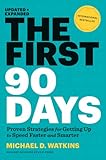
The First 90 Days
Michael D. Watkins · 2003 · Foundation · about 6 h · $
Not a quant book, but worth adding if your EMBA coincides with a new role, which is common.<!-- VERIFY --> Watkins sets out how to diagnose a new situation, secure early wins and build the right relationships. Read it last, just before the program starts, because the hardest part of the first term is often doing a new job and a degree at the same time.
Full review comingBuy on Amazon ↗