
Leadership and Organisational Behaviour · Book review
High Output Management
Andrew S. Grove · first published 1983 · 243 pages
- Core
- About 8 hours
- $ · paperback
By Antoine Marchand · Last reviewed
Read it if
- First-time managers of managers
- Operations and engineering leaders who think in systems
Skip it if
- You want a book about inspiration or culture
- You run a very small team with no managers below you
Who it is for
This is the book for a first-time manager of managers. Once there is a layer between you and the people doing the work, your output stops being what you produce and becomes what your organization produces. Most people make that shift without any method. Grove gives you one.
It suits operations and engineering leaders especially well. Grove ran manufacturing at Intel before he ran the company, and he writes like it. If you think in flows, bottlenecks and indicators, the book will feel like a description of how you already wish your organization worked.
As an engineer by training, I find it the most honest management book I know. It does not ask you to be inspiring. It asks you to be useful, and it tells you how to measure your usefulness.
Who should skip it
Skip it if you want a book about inspiration, purpose or culture. Grove has views on motivation, but they are practical and unsentimental, and there are no stories of turnarounds driven by a leader's vision.
Skip it, too, if you run a small team with no managers below you. Much of the book's value comes from the idea of the manager working through other managers, and from the mechanics of meetings, planning and dual reporting in a larger organization. A team lead with five direct reports will find useful pages, but not enough of them to justify the whole book.
The ideas that matter
A manager's output is the output of the organization
Grove's central definition is that a manager's output is the output of the units under their supervision plus the units they influence. Your own tasks count only to the extent they change that number.
This sounds obvious and is routinely ignored. A director who spends a week personally rescuing a customer account may feel productive while the eight teams below them drift. Grove's definition forces the question of which of your activities move the whole group's output most, and he argues that managers should spend their time on those high-yield activities first.
Run the business like a production line
The opening part uses a breakfast factory, producing eggs, toast and coffee, to explain limiting steps, inventory, inspection and indicators. It is an unlikely teaching device, and it is the clearest introduction to operations thinking I know for non-operations readers.
The lessons carry straight into management. Find the limiting step and plan around it. Catch problems at the lowest-value stage. Watch leading indicators rather than results that arrive too late to act on. Grove also recommends pairing indicators, so that measuring one effect, such as speed, is balanced by measuring its counter-effect, such as quality. That single idea would fix a lot of the dashboards that end up in board decks.
One-on-ones belong to the subordinate
Grove treats the one-on-one as the main way information and know-how pass between a manager and a direct report. His rules are specific: the meeting belongs to the subordinate, who sets the agenda, and its frequency should depend on how experienced that person is at the task in front of them.
That second point connects to his idea of task-relevant maturity. Someone new to a task needs close, structured supervision; someone seasoned needs little more than agreement on objectives. The same person can sit at different levels for different tasks. It is a more useful idea than most leadership-style frameworks because it is about the task, not the personality.
Meetings are the medium of managerial work
Grove does not apologize for meetings. He argues that a large share of a manager's work happens in them and splits them into process-oriented meetings, held on a regular schedule, and mission-oriented ones, called to solve a specific problem. Each type has its own rules, and the mission-oriented meeting should have a clear owner and end with a decision.
His decision model is the part people quote: open discussion where everyone speaks, a clear decision, then full support from everyone, including those who disagreed. It is close to what later became known as "disagree and commit".
Planning with objectives and key results
Grove's version of management by objectives, with an objective paired to measurable key results, is widely credited as the origin of OKRs. His treatment is short and practical, and his warning is the one most OKR rollouts ignore: too many objectives means no focus.
Where it is wrong or dated
The examples are from Intel in the late 1970s and early 1980s, and the technology of management is paper. Memos, printed reports and mailboxes appear where you would now have dashboards and chat. The translation is easy, but it is constant.
The organization Grove describes is large, hierarchical and co-located. Remote and distributed teams change how one-on-ones and meetings work, and the book has nothing to say about that. Neither does it address managing across cultures; Grove writes from inside one American company, and some of his directness would need adjusting in many Asian or European workplaces.
His views on performance reviews and on motivation are the most dated parts. He treats the annual appraisal as one of the most important things a manager does. Many companies have since moved to more frequent feedback, and the evidence on rating scales is less kind than Grove assumed.
Later editions added a new introduction but left the body largely unchanged. Do not expect updated examples.
If you only have a weekend
Start with the breakfast factory chapters in the opening part. They set up the vocabulary, limiting steps and indicators, that the rest of the book uses.
Next, read the chapters on managerial output and high-yield activities, then the ones on meetings and one-on-ones. Those are the pages you can apply on Monday morning.
If time remains, read the chapter on task-relevant maturity and the material on planning and objectives. Leave the chapters on compensation, hiring and dual reporting for later; they are useful, but more specific to large organizations.
What to read instead
If you have just moved from individual work into your first management role and your problem is your own calendar, not a team of teams, read The Effective Executive first. Drucker is shorter, more about judgment and time, and needs no organization beneath you to be useful.
Grove is the better choice once you manage managers. The two books complement each other well: Drucker tells you what to pay attention to, Grove tells you how to run the system that does the work. Both appear on the leadership and organizational behavior and operations shelves.
What to read next
Format I recommend: paperback.
Affiliate links. I earn a small commission; the price is the same for you.
About the reviewer
Antoine Marchand is an engineer by training (master's and doctorate) who took an MBA mid-career and spent more than thirty years in commercial leadership at international industrial companies, including a decade in Asia. He reads business books the way he ran his teams: looking for what actually works.
More in leadership and organisational behaviour
The full leadership and organisational behaviour reading list →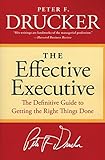
The Effective Executive
Peter F. Drucker · 1967 · Foundation · about 5 h · $
“Short, old and still the best book on how a senior person should spend their time. Read the chapter on time first.”

The Goal
Eliyahu M. Goldratt & Jeff Cox · 1984 · Foundation · about 9 h · $
“A business novel that teaches bottleneck thinking better than any textbook. The plot is corny; the idea is permanent.”

The Personal MBA
Josh Kaufman · 2010 · Foundation · about 9 h · $
“The best single map of business vocabulary, but a map is not the territory: use it to orient, not to decide.”
Also in: Operations, General Management