Leadership and Organisational Behaviour · Book review
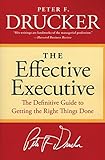
The Effective Executive
Peter F. Drucker · first published 1967 · 208 pages
- Foundation
- About 5 hours
- $ · paperback
By Antoine Marchand · Last reviewed
Read it if
- Anyone just promoted from doing the work to deciding what work gets done
- Executives whose calendar runs them
Skip it if
- You want modern productivity tooling
- You are allergic to 1960s prose
Who it is for
This book is for the person who was good at the work and has just been told to decide what work gets done. The engineer who now runs the engineering group. The top salesperson who now owns the region. The job changed, but the calendar still looks like the old job, only fuller.
Drucker's starting point is that effectiveness is a habit you can learn, not a talent you either have or lack. That framing matters for a newly promoted manager. It means the problem is method, and method can be fixed.
It is also for executives whose calendars run them. If your week is set by other people's meeting invitations and you finish Friday unsure what you contributed, this book names the problem precisely and gives you a way out that needs no software.
Drucker defines "executive" broadly: anyone in a knowledge role who is expected, by virtue of position or knowledge, to make decisions that affect the results of the whole organization. So a senior analyst qualifies. Title is not the test.
Who should skip it
Skip it if you want modern productivity tooling. There is nothing here about inbox rules, calendar apps, task managers or meeting software. Drucker writes about secretaries and paper. If you want a system with steps and templates, this is the wrong book.
Skip it, too, if 1960s prose genuinely puts you off. The sentences are long, the examples are from mid-century American corporations and government, and the executive is almost always "he". I think the ideas survive the packaging, but some readers will not get past it, and that is a fair reason to choose something else.
The ideas that matter
Know where your time actually goes
Drucker's method is to record time as you spend it, not as you remember spending it, then cut what does not need doing, delegate what someone else can do, and stop wasting other people's time. His claim is that memory is a poor guide here, and that most executives overestimate how much time they give to important work.
The second half of the argument is the one people forget. Important work needs large, uninterrupted blocks, and fifteen-minute fragments scattered across a week do not add up to one useful afternoon. For anyone writing a strategy paper or a budget, this is the most practical point in the book.
Ask what you can contribute
Drucker wants executives to look outward, at results, rather than downward, at effort. The question is what you can contribute that would significantly change the organization's performance, not what you are busy with.
For a commercial leader this lands hard. A sales director can spend a whole quarter on internal reporting and account reviews and contribute nothing a customer would notice. Asking the contribution question every few months is a cheap way to catch that drift.
Staff for strength, not to avoid weakness
The chapter on making strength productive argues that you hire and assign people for what they do exceptionally well, and accept the weaknesses that come with it. Building a job around an imagined well-rounded person produces mediocrity.
This applies upward too. Drucker suggests working with your own boss's strengths rather than trying to fix the boss. It is unsentimental advice, and it is correct.
First things first, and deciding what to drop
Concentration is Drucker's word for doing one thing at a time, and doing first things first. The less quoted half is his idea of "posteriorities": deciding deliberately which tasks to abandon.
Most management teams are good at adding priorities and poor at removing them. A list of twelve strategic initiatives is a list of none. The posteriorities idea gives you language for the conversation where something gets stopped.
Decisions are about the problem, not the answer
The closing chapters on decision-making argue that the first job is to work out whether a problem is generic, needing a rule, or truly exceptional. Drucker also wants explicit boundary conditions, what the decision must achieve, and he wants disagreement on the table before the decision is taken, not after.
He uses Alfred Sloan at General Motors as an example of an executive who would postpone a decision when everyone agreed, because unanimity suggested nobody had thought hard enough. Whether or not you like the example, the principle holds up in a board meeting today.
Where it is wrong or dated
The setting is the large, stable, mid-century organization with a clear hierarchy, a secretary to keep the time log, and long careers inside one company. Much of the advice still works in a flat or matrixed organization, but you have to translate it yourself.
The book also predates email, messaging and video calls, which fragment time far more than anything Drucker describes. His diagnosis is more true now than when he wrote it. His remedies, though, assume a level of control over your calendar that many middle managers do not have, and he does not say much about how to get it.
The examples lean on government, the military and a handful of American corporations. Readers outside the US, or in fast-growing companies, will find few situations that look like their own. The language is gendered throughout.
There is also very little about managing a team day to day. Drucker writes about the executive's own effectiveness. How to run meetings, coach direct reports or measure a group's output is mostly left to other books.
If you only have a weekend
Read "Know Thy Time" first. It is the chapter the whole book rests on, and the one most likely to change how you work on Monday.
Then read "What Can I Contribute?" and "First Things First". Together they give you the question to ask and the discipline to act on the answer.
If you have a Sunday afternoon left, read the two chapters on decision-making, "The Elements of Decision-Making" and "Effective Decisions". They are the densest part of the book and the most useful for anyone who sits on a leadership team.
You can skim the opening chapter on why effectiveness can be learned and the short conclusion. They restate the argument rather than add to it.
What to read instead
If you manage managers, or you need the mechanics of running a group rather than the principles of running yourself, read High Output Management. Andy Grove covers one-on-ones, meetings, performance reviews and how to measure a team's output, all of which Drucker leaves out.
The two books cover different ground. Drucker is about your own time and judgment, Grove about the system you run. If you have to pick one and you have just been promoted out of individual work, start with Drucker. If you already have managers reporting to you, start with Grove.
Both sit on the leadership and organizational behavior and general management shelves.
What to read next
Format I recommend: paperback.
Affiliate links. I earn a small commission; the price is the same for you.
About the reviewer
Antoine Marchand is an engineer by training (master's and doctorate) who took an MBA mid-career and spent more than thirty years in commercial leadership at international industrial companies, including a decade in Asia. He reads business books the way he ran his teams: looking for what actually works.
More in leadership and organisational behaviour
The full leadership and organisational behaviour reading list →
High Output Management
Andrew S. Grove · 1983 · Core · about 8 h · $
“The operating manual for middle and senior managers. Grove treats management as production, and it works.”

The Personal MBA
Josh Kaufman · 2010 · Foundation · about 9 h · $
“The best single map of business vocabulary, but a map is not the territory: use it to orient, not to decide.”

The Ten-Day MBA
Steven Silbiger · 1993 · Foundation · about 12 h · $
“Closer to the actual MBA syllabus than any other primer, with the dated case examples that come with it.”
Also in: General Management