Strategy · Book review
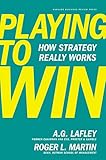
Playing to Win
A.G. Lafley & Roger L. Martin · first published 2013 · 272 pages
- Core
- About 7 hours
- $ · paperback
By Antoine Marchand · Last reviewed
Read it if
- Leaders running a strategy process with a team
- Brand and product heads in consumer businesses
Skip it if
- You are in a B2B industrial or regulated business and want examples from it
- You already use the cascade at work
Who it is for
You have been asked to lead a strategy process, not write a document alone. You will have a leadership team in a room for two days. You need a structure that gets them from opinions to decisions.
Lafley and Martin give you that structure. The book frames strategy as a short sequence of linked questions . Each answer narrows the next, so the group cannot agree on an ambition and then avoid the hard choices underneath it.
It fits brand and product heads in consumer businesses especially well. Lafley ran Procter & Gamble , and nearly every example comes from P&G brands . If you manage a consumer product, the cases will read like your own work.
Who should skip it
If you work in a B2B industrial or regulated business and want examples from your world, you will not find many here. The logic still applies to industrial markets. The illustrations do not, and you will spend effort translating detergent and skin care into distributors, specifications and long qualification cycles.
Skip it too if your company already uses the cascade. Many large firms and consultancies have adopted it . If you have filled in the five boxes at work, the book adds background and examples, but not a new method.
The ideas that matter
Strategy is five integrated choices
The core of the book is the strategy choice cascade: a winning aspiration, where to play, how to win, the capabilities you must have, and the management systems that support them . The authors stress that the five must fit together .
For a manager, the useful part is that each box constrains the others. An aspiration to lead a premium segment rules out some markets. The markets you choose decide what winning there looks like. If the capabilities and systems do not match, the strategy is a wish.
Where to play and how to win are the heart of it
Lafley and Martin treat the middle two choices as the center of strategy . Where to play covers which customers, geographies, channels and product categories. How to win is the specific advantage that makes you the better choice in those places.
The discipline is in answering them together. A team that picks markets without a credible way to win in them has made a list, not a strategy. This is the same point Rumelt makes about coherence, put in a form a workshop can use.
Ask what would have to be true
The book's most useful technique, in my view, is to stop debating which option is right and ask instead what would have to be true for each option to work . The team then tests the conditions it is least sure about.
This changes the tone of strategy meetings. People stop defending their favorite idea and start naming the facts that would prove it wrong. It also produces a short research agenda: the two or three things you need to find out before committing capital.
Capabilities and systems are part of the strategy
Many strategy documents stop at the market choice. Lafley and Martin push on to the capabilities you need and the management systems that build and measure them .
This is where most strategies fail in practice. A decision to win on service needs a service organization, metrics and budgets that match. If next year's operating plan does not change, the strategy has not happened.
Where it is wrong or dated
The P&G focus is the obvious limit. The cases are almost all from one company, told by its former chief executive . That gives the stories depth, but it also gives them a flattering slant. The failures and abandoned bets get less space than the successes.
The book is lighter on industry analysis and competitor response than the classical texts. It assumes you can assess a market's attractiveness and your relative position , but gives that work less space than the cascade itself.
The cascade can also turn into a form-filling exercise. Five boxes on a slide look like a strategy even when every box contains a generic answer. The authors warn against this , but the format invites it, and a team without strong facilitation will produce exactly that.
Finally, the setting is a large, well-resourced company with established brands. Smaller firms, or businesses whose fortunes depend on a few large customers or on regulators, will find some of the advice harder to apply.
If you only have a weekend
Start with the opening chapter, which sets out the cascade as a whole . Then read the chapters on where to play and how to win , since those are the core of the method.
Next, read the chapter on the strategy logic flow and the material on asking what would have to be true . This is the part you will use in meetings.
The chapters on capabilities and management systems can wait until you are building the operating plan .
What to read instead
If what you need is a test for whether a strategy is any good, rather than a process for producing one, read Good Strategy Bad Strategy. Rumelt's examples range more widely than consumer goods, and his diagnosis-first approach often suits industrial and regulated businesses better.
My preference is to read Rumelt before running a cascade, so the team knows what a weak answer looks like. The strategy hub sets out the full reading order, and the marketing hub covers the brand side of the same choices.
What to read next
 Read insteadGood Strategy Bad StrategyRichard Rumelt · Core · 9 h · $
 Pair with, when short on timeKey Strategy ToolsVaughan Evans · Foundation · 1 h · $$
Format I recommend: paperback.
Affiliate links. I earn a small commission; the price is the same for you.
About the reviewer
Antoine Marchand is an engineer by training (master's and doctorate) who took an MBA mid-career and spent more than thirty years in commercial leadership at international industrial companies, including a decade in Asia. He reads business books the way he ran his teams: looking for what actually works.
More in strategy
The full strategy reading list →Good Strategy Bad Strategy
Richard Rumelt · 2011 · Core · about 9 h · $
“The most useful strategy book for a working executive: it teaches you to spot a fake strategy in your own planning deck.”

The Innovator's Dilemma
Clayton M. Christensen · 1997 · Core · about 8 h · $
“The theory every incumbent executive needs to understand, illustrated with disk drives you will have to push through.”
Competitive Strategy
Michael E. Porter · 1980 · Advanced · about 16 h · $$
“The source text for industry analysis. Dense and long, but every strategy framework you meet afterwards borrows from it.”
Also in: Marketing