Marketing · Book review
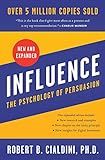
Influence
Robert B. Cialdini · first published 1984 · 592 pages
- Foundation
- About 9 hours
- $ · paperback
By Antoine Marchand · Last reviewed
Read it if
- Marketing, sales and negotiation roles
- Anyone who wants to recognise when they are being worked
Skip it if
- You want a marketing strategy book; this is psychology
- You are looking for the latest research rather than the classic
Who it is for
Anyone in marketing, sales or negotiation should read this book, because the principles in it are already being used in their meetings. Pricing pages, trial offers, reference customers, "only three slots left this quarter": these are Cialdini's principles at work, whether or not the person deploying them has read him.
The second reader is anyone who wants to recognize when they are being worked. That includes procurement leads facing a skilled sales team, executives fielding a pitch from a consultancy, and managers being lobbied by their own reports. The book is as useful as a defense manual as it is as a playbook.
It sits in both our marketing and negotiation sequences as a foundation read. It is cheap, readable and full of examples.
Who should skip it
Skip it if you want a marketing strategy book. This is social psychology. It will tell you why a testimonial works; it will not tell you which segment to target, how to position against a competitor or how to set a price.
Skip it also if you want current research. Influence is a classic built largely on studies from the 1960s to the 1980s . Some of that work has held up well; some has not. If you need the latest evidence on persuasion, this is the wrong starting point.
The ideas that matter
Compliance runs on shortcuts
The book's opening argument is that people use mental shortcuts to decide quickly, and that each principle exploits one of those shortcuts . Most of the time the shortcuts serve us well. The trouble starts when someone triggers them deliberately. For a manager, the useful takeaway is that a fast yes in a meeting is not always a considered one, on either side of the table.
Reciprocation and commitment drive most sales processes
Reciprocation is the obligation people feel to return a favor, even an unrequested one . Commitment and consistency is the pressure to act in line with what we have already said or done . Together they explain why free samples, small initial agreements and written pilot goals move deals forward. They also explain why a negotiator should be wary of accepting small concessions early, and of agreeing to framing questions that box in the later answer.
Social proof and authority stand in for judgment
People look to others like them when unsure what to do, and they defer to signals of expertise . In B2B selling this is the logic of the reference customer and the industry analyst quote. Inside a company it is the reason a proposal with a respected sponsor's name on it gets an easier hearing. Knowing that does not stop the effect, but it lets you ask whether the evidence would persuade you without the name attached.
Liking and scarcity are the easiest to abuse
We say yes more readily to people we like, and we value what seems to be running out . Both are legitimate when true. Both are the core of most high-pressure tactics: the overly friendly account manager, the expiring discount. The book's chapters suggest a defense for each principle, usually by separating your feelings about the offer from your feelings about the person or the deadline .
Unity, the seventh principle
The new and expanded edition published in 2021 adds a seventh principle, unity: we are more easily persuaded by people we see as part of our group . Cialdini first developed it in his 2016 book Pre-Suasion . For managers it is the logic of shared identity, the "we" in a team, a region or a profession, and it is a reminder that persuasion inside an organization often depends on who is seen as one of us.
Where it is wrong or dated
Some of the evidence has not survived. The social proof chapter has long used the 1964 murder of Kitty Genovese as an example of bystanders failing to act . Later reporting, including a 2016 New York Times editor's note, acknowledged that the original account of thirty-eight passive witnesses was seriously exaggerated . The broader bystander research stands on other studies, but the headline example does not.
Social psychology has also been through a replication crisis. The Open Science Collaboration's 2015 paper in Science reproduced fewer than half of a sample of published psychology findings . Not every study Cialdini cites has been retested, and readers should treat effect sizes from small older experiments with caution.
The book is better at explaining compliance than at warning about its costs. Tactics that work once can damage trust over a long relationship, and the commercial cost of being seen as manipulative gets less attention than the mechanics.
Editions matter more here than for most classics. Earlier editions cover six principles . The 2021 new and expanded edition adds unity, updates examples and adds reader reports . Buy the newer edition if you can; the price difference is small.
If you only have a weekend
Read the opening chapter on how the shortcuts work . Then read the chapters on reciprocation and commitment, which matter most for selling and negotiating . Then read social proof, keeping in mind the caveats above.
If you have time left, read the scarcity chapter and, in the new edition, the chapter on unity . Skim the rest for the defense sections at the end of each chapter . Afterward, take one of your own sales or procurement processes and mark which principle each step relies on.
What to read instead
If your goal is negotiating rather than understanding persuasion in general, read Never Split the Difference. It is narrower and more tactical, built around how to handle a counterparty in the room. It is the better choice when you have a deal to close soon and want techniques rather than theory.
For the research on judgment that sits underneath many of these shortcuts, Thinking, Fast and Slow is the deeper read.
What to read next
 Read insteadNever Split the DifferenceChris Voss & Tahl Raz · Foundation · 7 h · $
Format I recommend: paperback.
Affiliate links. I earn a small commission; the price is the same for you.
About the reviewer
Antoine Marchand is an engineer by training (master's and doctorate) who took an MBA mid-career and spent more than thirty years in commercial leadership at international industrial companies, including a decade in Asia. He reads business books the way he ran his teams: looking for what actually works.
More in marketing
The full marketing reading list →
Getting to Yes
Roger Fisher, William Ury & Bruce Patton · 1981 · Foundation · about 5 h · $
“The vocabulary of principled negotiation: interests, options, criteria, BATNA. Strong on framework, light on hardball.”
Playing to Win
A.G. Lafley & Roger L. Martin · 2013 · Core · about 7 h · $
“Five questions that turn strategy into a set of choices. Excellent structure, a little too fond of Procter & Gamble.”

Financial Intelligence
Karen Berman & Joe Knight · 2006 · Foundation · about 7 h · $
“The finance book I would hand to any newly promoted manager. Plain English, and honest about where the numbers are judgment.”
Also in: Negotiation