Data and Decision-Making · Book review
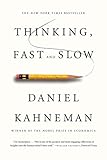
Thinking, Fast and Slow
Daniel Kahneman · first published 2011 · 499 pages
- Core
- About 14 hours
- $ · audiobook
By Antoine Marchand · Last reviewed
Read it if
- Anyone who makes forecasts, budgets or hiring decisions
- Readers who want the source behind behavioural economics
Skip it if
- You want a practical decision checklist
- You have one weekend: read Thinking in Bets instead
Who it is for
Read this if you make forecasts, set budgets or hire people. Those are the decisions where the errors Kahneman describes cost the most, and where a manager can do something about them. Anchoring on last year's number, trusting a confident interviewer's gut, assuming this project will run on time when the last five did not: the book explains why these happen and why they keep happening to smart people.
It is also for readers who want the source rather than the popularization. A great deal of what gets taught as behavioral economics, in MBA programs and in business books, traces back to the research Kahneman did with Amos Tversky. This book is his own account of it, written for a general reader.
I would put it on the shelf of anyone who signs off on capital requests. The chapters on overconfidence alone justify that.
Who should skip it
Skip it if you want a practical decision checklist. Kahneman is a psychologist describing how judgment works and fails. He offers some remedies, but the book is mostly diagnosis, and he is candid that knowing about a bias does little to protect you from it.
Skip it, too, if you have one weekend. At thirty-eight chapters, the book is long and uneven, and the most useful material is spread across it. A busy reader with two days will get more applied value from a shorter book written for people who make bets under uncertainty.
The ideas that matter
Two systems, and what you see is all there is
Kahneman organizes the book around two modes of thinking: System 1, fast, automatic and intuitive, and System 2, slow, effortful and deliberate. He is clear that these are a useful fiction, not two places in the brain.
The idea a manager should keep is the one he abbreviates as WYSIATI, "what you see is all there is". System 1 builds the most coherent story it can from whatever information is in front of it, and does not flag what is missing. A tidy board deck with three data points will feel more convincing than a messy one with thirty. The fix is a habit: before deciding, ask what you would need to know that you have not been shown.
Anchors move numbers more than you think
Kahneman shows that an arbitrary number, presented first, pulls later estimates toward it, even when people know it is arbitrary. This has obvious consequences in pricing, negotiation and budgeting.
Every budget cycle that starts from last year's figure plus or minus a percentage is an anchoring exercise. So is the first price on the table in a negotiation. The practical response is to set your own reference point before you see anyone else's, and to write it down.
The planning fallacy and the outside view
Kahneman describes how plans and forecasts are built from the inside, from the specifics of this project, and are almost always too optimistic. His remedy is the outside view: find a reference class of similar projects, see how they turned out, and start from that distribution.
He illustrates it with a curriculum project of his own, where the team's estimate was a fraction of what similar projects had taken. For anyone approving a capital project, a system implementation or a market entry, this chapter is the most useful thing in the book. Ask for the base rate before you look at the plan.
Regression to the mean
Extreme results tend to be followed by less extreme ones, purely by chance. Kahneman tells the story of flight instructors who believed that praise made trainees worse and criticism made them better, when they were watching regression.
Managers make the same mistake with sales territories, plant performance and people. The rep who had a record quarter is likely to fall back; the one who had a terrible quarter is likely to improve. Neither movement proves your intervention worked.
Losses loom larger than gains
Prospect theory, the work for which Kahneman received the Nobel memorial prize in economics, holds that people judge outcomes as gains or losses relative to a reference point, and that losses hurt more than equivalent gains please. This explains why teams cling to failing projects, why price increases provoke more reaction than equivalent discounts, and why framing a choice as avoiding a loss changes the answer.
Where it is wrong or dated
The weakest part is the material on priming in the early chapters, especially chapter 4, "The Associative Machine". Several of the studies Kahneman presents there as settled, such as people walking more slowly after reading words associated with old age, have failed to replicate. Kahneman acknowledged this publicly: he wrote an open letter to priming researchers in 2012 urging them to address the replication problem, and later said he had placed too much faith in small, underpowered studies.
Ego depletion, the idea that self-control draws on a limited resource that gets used up, also appears in the book and has fared badly in large replication efforts. Treat it with caution.
None of this undermines the core findings on anchoring, the planning fallacy, regression and loss aversion, which rest on much stronger evidence. But a reader should know that the book's confident tone is not equally earned across all its chapters.
The book has blind spots for a manager. It says little about how groups and organizations amplify or correct individual bias, and it offers few tools you could put into a decision process. Kahneman's later work on noise addresses some of this, but it is a separate book.
If you only have a weekend
Skim Part 1, "Two Systems", for the vocabulary, but skip the priming material in chapter 4.
Then read the chapter on anchors, chapter 11, and the chapter on regression to the mean, chapter 17. Both are short and directly applicable to budgets and performance reviews.
Spend the most time on Part 3, "Overconfidence", in particular the chapters on the illusion of validity, intuitions versus formulas and the outside view, chapters 20, 21 and 23. That section is the best case for building structure into hiring and forecasting.
Finish with chapter 26 on prospect theory. The final part, "Two Selves", on experienced versus remembered well-being, is interesting but less useful at work, and you can leave it.
The audiobook works well for this kind of selective reading, since many chapters are built around experiments told as stories.
What to read instead
If you have one weekend and want something you can apply on Monday, read Thinking in Bets. Annie Duke takes many of the same ideas and frames them around decisions under uncertainty, separating the quality of a decision from the quality of its outcome. It is much shorter and far more practical.
Kahneman remains the better choice if you want to understand where the ideas came from and how strong the evidence is behind each one. Both sit on the data and decision-making shelf.
What to read next
 Read insteadThinking in BetsAnnie Duke · Foundation · 5 h · $
Format I recommend: audiobook.
Affiliate links. I earn a small commission; the price is the same for you.
About the reviewer
Antoine Marchand is an engineer by training (master's and doctorate) who took an MBA mid-career and spent more than thirty years in commercial leadership at international industrial companies, including a decade in Asia. He reads business books the way he ran his teams: looking for what actually works.
More in data and decision-making
The full data and decision-making reading list →
Good Strategy Bad Strategy
Richard Rumelt · 2011 · Core · about 9 h · $
“The most useful strategy book for a working executive: it teaches you to spot a fake strategy in your own planning deck.”

High Output Management
Andrew S. Grove · 1983 · Core · about 8 h · $
“The operating manual for middle and senior managers. Grove treats management as production, and it works.”

Playing to Win
A.G. Lafley & Roger L. Martin · 2013 · Core · about 7 h · $
“Five questions that turn strategy into a set of choices. Excellent structure, a little too fond of Procter & Gamble.”
Also in: Managerial Economics